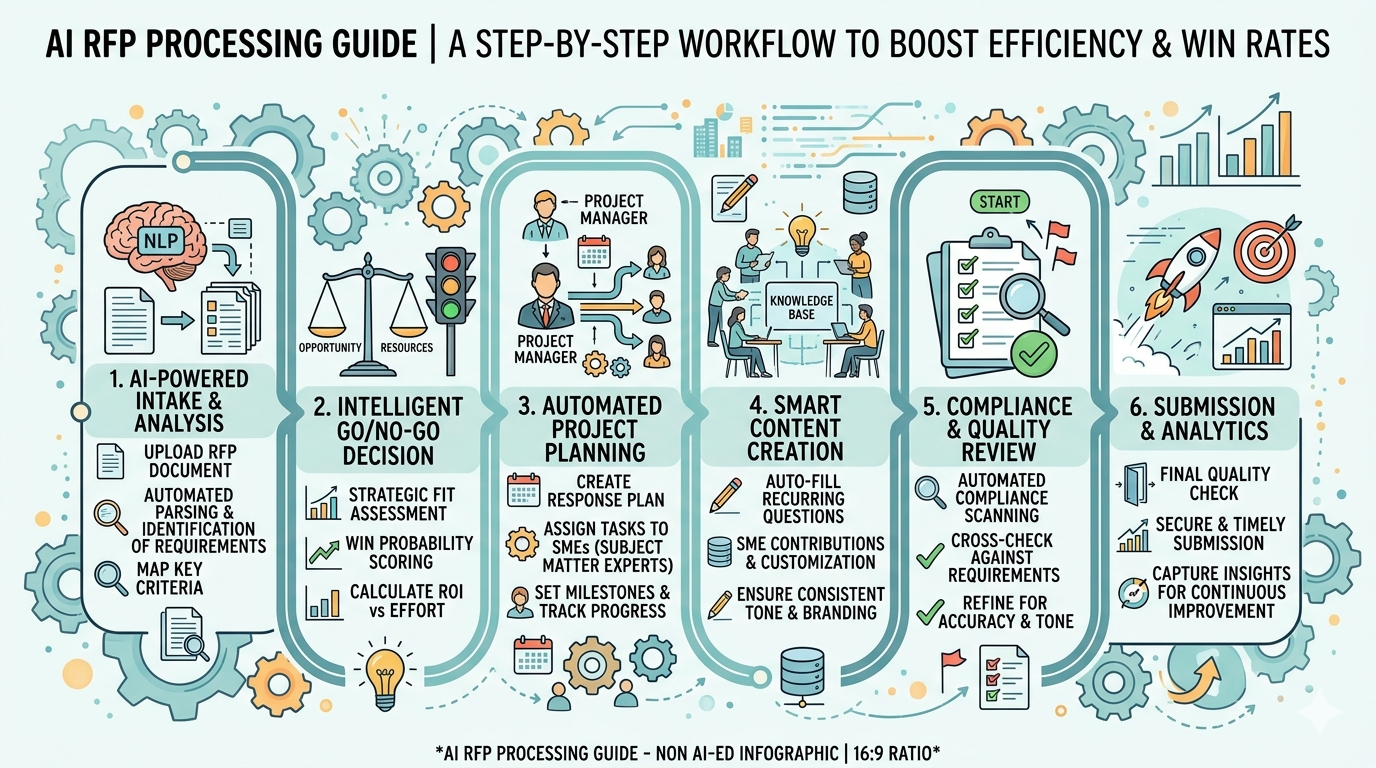
What Is AI-Driven RFP Processing?
AI-driven RFP processing uses natural language processing (NLP), document parsing, and workflow automation to extract requirements, classify questions, score vendor fit, and reduce manual review time across procurement documents. It does not replace human judgment it removes the repetitive, time-consuming steps that slow teams down before that judgment is applied.
Why Companies Automate RFP Processing
- Manual data entry copying requirements from PDFs into trackers and response templates
- Slow requirement extraction reading through 40–200 page documents to identify what needs a response
- Inconsistent scoring different reviewers applying different criteria to the same bid
- Missed deadlines a fragmented review process routinely leads to late or incomplete submissions
- Fragmented review across teams legal, technical, commercial, and compliance stakeholders working in silos
- Repetitive drafting work most RFPs ask overlapping questions that teams have answered dozens of times before
How AI-Driven RFP Processing Works
- Ingest the RFP AI parses PDFs, Word, Excel, or web forms into structured sections
- Extract requirements and deadlines identifies mandatory requirements, dates, and evaluation criteria
- Classify sections tags items like technical, compliance, commercial, or security
- Match knowledge base retrieves similar past answers with confidence scoring
- Score fit and flag risks highlights gaps, tight deadlines, or uncertainties
- Generate draft responses structured outputs with citations for human review
Manual vs. AI-Driven RFP Processing
Best Use Cases
- Government procurement predictable formats
- Enterprise questionnaires high repetition (50–300 questions)
- Compliance-heavy RFPs multi-standard cross-referencing
- High-volume pipelines continuous improvement over time
Where AI Helps vs Humans
AI excels at parsing, extraction, retrieval, drafting, and workflow automation.
Humans are required for legal review, pricing, strategy, and final approvals.
Limitations
- Dependent on knowledge base quality
- Weak for novel or one-off RFPs
- Requires human validation
- Risk of incorrect compliance statements
- Integration complexity
- Data security concerns
Common Mistakes
- No structured review process
- No curated knowledge base
- Starting with edge cases
- Confusing summaries with compliance validation
- Not measuring performance improvements
Conclusion
AI handles repetitive work (60–80%), while humans focus on strategic and sensitive decisions. Start with high-volume, repeatable RFPs for fastest ROI.
Bridge Homies helps teams implement AI-driven RFP workflows. Get in touch.