Every few years, the tech industry discovers a new technology that promises to completely transform business operations. Blockchain dominated that conversation for years. Today, Artificial Intelligence sits at the center of nearly every startup pitch, enterprise roadmap, and investor presentation.
But beneath all the hype lies a much more practical question: which technology actually solves real business problems more effectively?
That question matters because businesses are not rewarded for adopting trendy technologies. They are rewarded for reducing operational costs, improving efficiency, and building systems that scale reliably.
Artificial Intelligence vs Blockchain: Understanding the Core Difference
The simplest practical explanation is this:
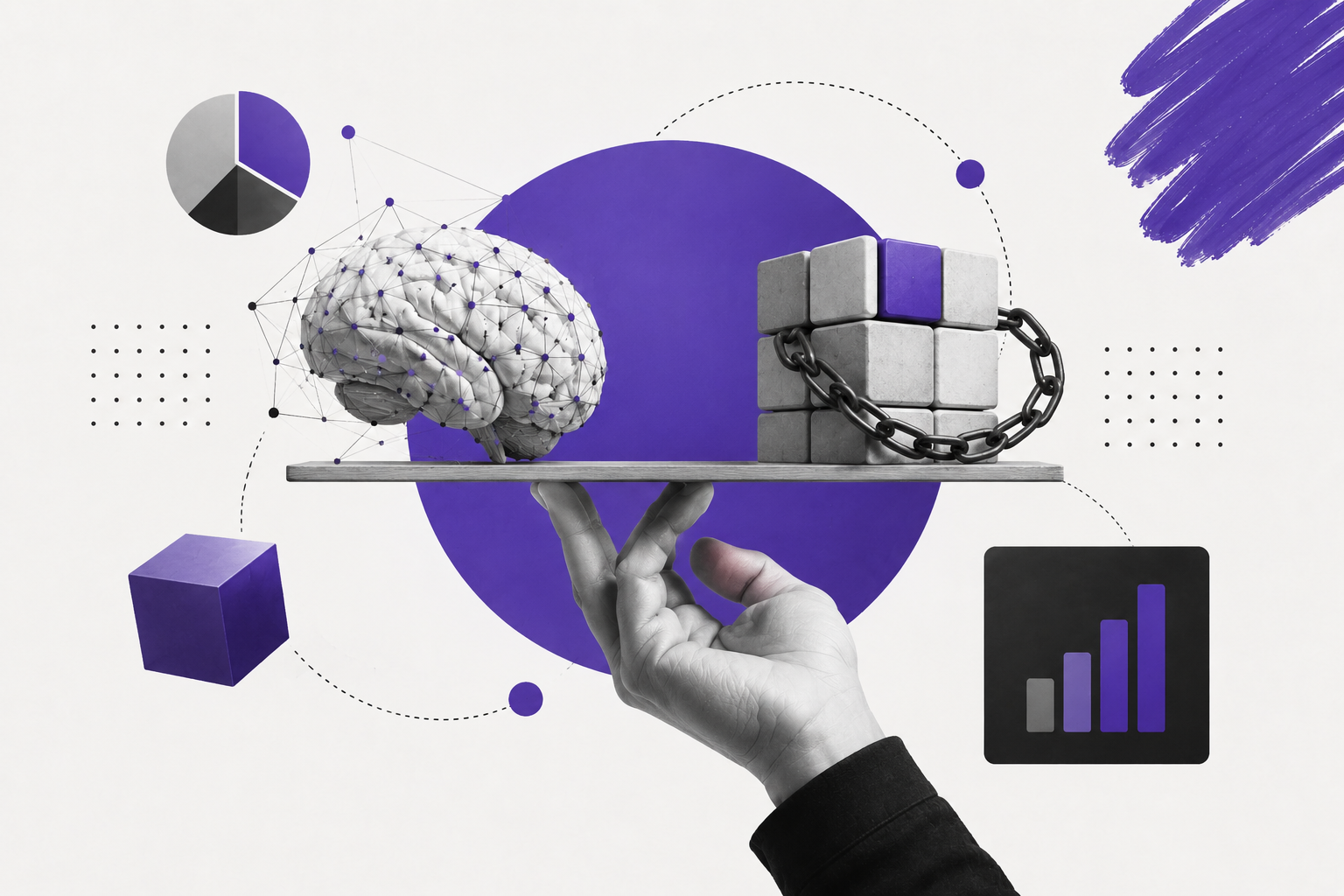
AI is about efficiency. Blockchain is about integrity.
Artificial Intelligence helps organizations process information faster, automate repetitive work, identify patterns, and improve decision-making. Blockchain focuses on trust, transparency, verification, and tamper-proof records.
Most companies today are struggling far more with inefficiency than decentralized trust systems. That reality alone explains why AI adoption is accelerating much faster across industries.
Why AI Is Seeing Faster Real-World Adoption
Most businesses are not looking for decentralization. They are looking for speed.
A hiring team overwhelmed with thousands of resumes does not care whether their infrastructure is distributed across nodes. They care about reducing screening time and finding better candidates faster.
At Bridge Homies, one practical example came from building AI-driven CV screening concepts designed to reduce hiring inefficiencies for large organizations.
Traditional hiring workflows often fail because manual review becomes inconsistent and slow. Recruiter fatigue introduces bias, while keyword-only filtering causes strong candidates to get ignored simply because their wording differs slightly from predefined terms.
- Manual review becomes too slow at scale
- Keyword matching misses relevant candidates
- Recruiter fatigue reduces screening quality
- Qualified applicants may get ignored due to formatting or wording differences
AI improves this process through semantic matching. Instead of relying on exact keywords, the system evaluates contextual relevance between skills, experience, and job requirements. This dramatically improves relevance scoring while reducing operational overload for HR teams.
The Reality Most AI Discussions Ignore
Most AI discussions online focus heavily on demos and futuristic promises. Production systems are very different.
AI systems hallucinate. They misinterpret similar-looking information. They generate outputs that appear correct while being factually inaccurate.
This becomes especially dangerous in environments involving legal workflows, financial systems, compliance automation, or healthcare data.
The misconception that AI can run entirely without supervision is one of the biggest operational risks companies face today.
- Human verification is still necessary
- Prompt consistency matters
- Structured safeguards are essential
- AI outputs require monitoring in production
The Hidden Cost of AI Infrastructure
Many founders assume the hardest part of AI is building the model or integrating APIs. In reality, infrastructure becomes the real challenge once products begin scaling.
GPU hosting costs rise rapidly, especially for image processing, inference-heavy workloads, and systems handling continuous requests. What appears affordable during prototyping can become significantly more expensive in production environments.
The difficult part is rarely making AI work once. The difficult part is making it work consistently, accurately, and affordably under real-world traffic conditions.
Many Businesses Asking for AI Actually Need Automation
Another growing trend is that many companies requesting AI do not actually require advanced AI systems. They require workflow automation.
There is a major difference between a workflow requiring intelligent reasoning and one requiring structured execution. Many repetitive business operations can be solved more effectively using automation pipelines, integrations, and rule-based systems without introducing unnecessary AI complexity.
The best technology decisions happen when businesses clearly understand the actual bottleneck before selecting the technology stack.
Why Blockchain Still Struggles Outside Finance
Blockchain remains extremely powerful in environments where trust, transparency, and immutability are essential. Cryptocurrency systems and decentralized finance are obvious examples.
Outside finance, however, adoption becomes significantly harder because most businesses prioritize simplicity, centralized control, and operational speed.
For many companies, traditional databases already solve the business problem effectively without adding the architectural complexity associated with decentralized systems.
This does not make Blockchain irrelevant. It simply means its strongest use cases remain concentrated in industries where trust itself is the core operational challenge.
Where AI Will Transform Traditional Software First
The next major wave of AI adoption will likely happen inside operational business software rather than standalone chatbot interfaces.
Inventory management systems, CRMs, reporting dashboards, and internal workflow tools are already beginning to absorb AI capabilities directly into their processes.
- Customer follow-ups
- Stock alerts
- Data entry
- Reporting workflows
- Operational monitoring
This is also why AI adoption currently feels far more practical to businesses than Blockchain. Companies can integrate AI incrementally into existing workflows while seeing measurable operational improvements relatively quickly.
Final Verdict: Artificial Intelligence vs Blockchain
Artificial Intelligence and Blockchain are not direct competitors. They solve fundamentally different categories of problems.
AI focuses on efficiency, automation, and operational intelligence. Blockchain focuses on trust, verification, and record integrity.
But when viewed from a practical business perspective, AI currently has broader utility because most organizations are overwhelmed by repetitive workflows, operational inefficiencies, and growing volumes of data.
AI helps businesses work smarter. Blockchain helps businesses prove trust.
That distinction explains why AI adoption is accelerating significantly faster across industries in 2026.