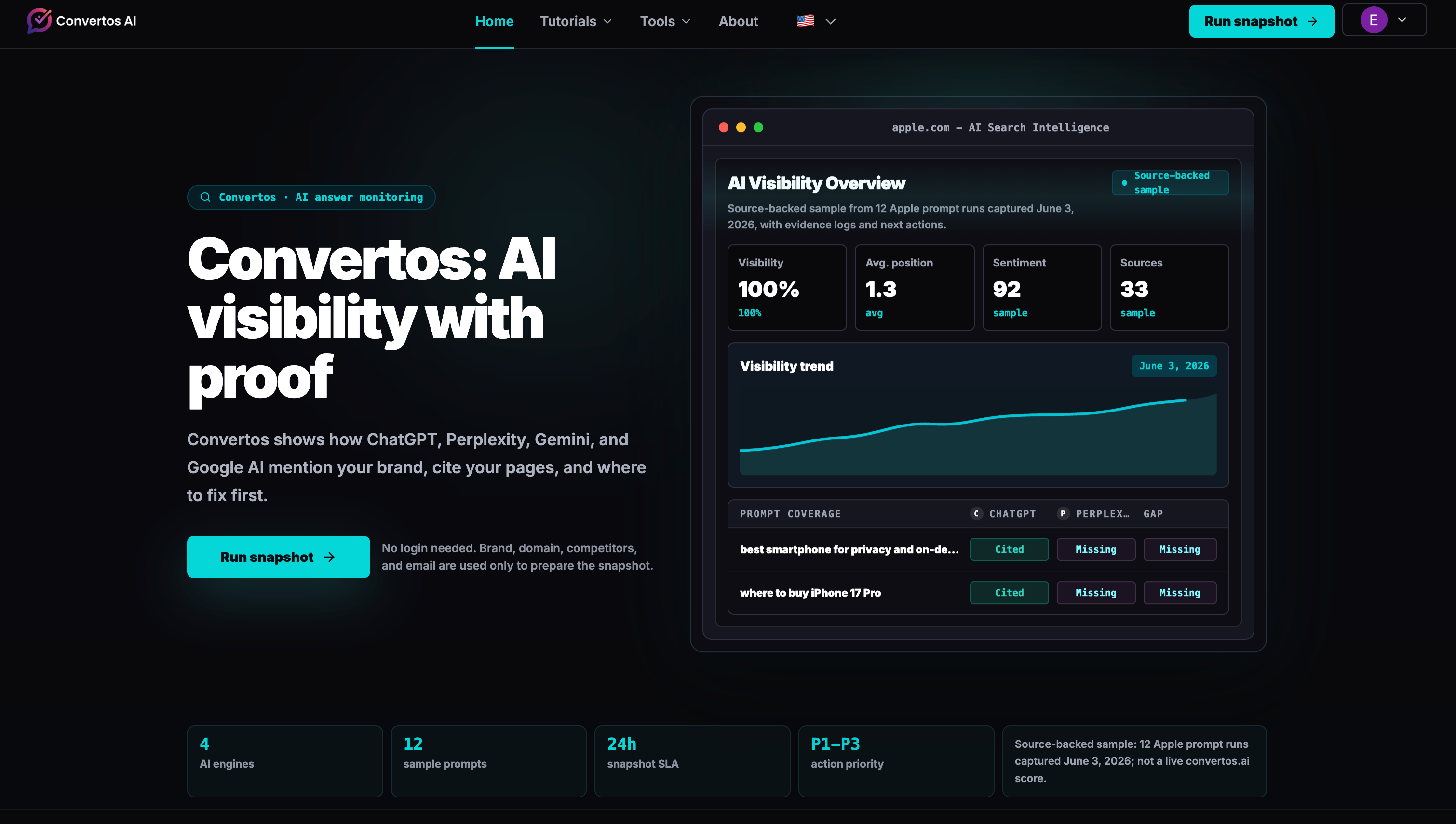
AI answer visibility has moved from a curiosity to an operating metric for SaaS teams. Buyers now ask ChatGPT, Perplexity, Gemini, and Google AI answers for product recommendations, comparisons, pricing explanations, implementation risks, and category definitions. If those systems describe your product incorrectly, omit your brand, or cite weak third-party sources, the issue is not only a content problem. It is a monitoring, evidence, and workflow problem.
For many teams, the first instinct is to take screenshots. A screenshot is useful as a snapshot, but it is weak as a system. It does not explain why the answer changed, which source influenced the model, whether the answer is accurate, or what the team should fix next. A better approach is to build an AI answer visibility dashboard that treats every answer as a measurable event with prompts, entities, citations, claims, competitors, and follow-up actions.
The goal is not to chase every mention. The goal is to understand whether public evidence about your product is clear enough for AI systems to summarize and cite. This is the same reason we built Convertos.ai for AI visibility monitoring: SaaS teams need a practical way to connect answer behavior with source quality, not another static report.
Why Screenshots and Spot Checks Stop Working
Most teams start monitoring AI answers the same way they started monitoring search rankings a decade ago: manually. Someone types a few branded prompts into ChatGPT once a month, screenshots the response, and drops it into a Slack channel. This works for a week or two, then quietly stops.
The reason it breaks down is that AI answers are not static. The same prompt asked on different days, on different models, or with slightly different phrasing can return a different set of sources, a different competitor list, and a different description of what your product does. Without a repeatable structure, there is no way to tell whether an answer changed because your content improved, because a competitor published something new, or because the model itself was updated. A dashboard exists to remove that guesswork by turning every answer into a comparable, dated record.
Building the Prompt Library
Start with a stable prompt library. Category discovery prompts ask which tools solve a problem. Comparison prompts ask how one tool compares with another. Use-case prompts describe a job to be done, such as monitoring ChatGPT citations after a content update. Risk prompts ask about pricing, security, data quality, and limitations. Branded prompts ask what the model thinks your company does.
A good prompt library covers all five categories, not just branded prompts. Category and use-case prompts are usually the most revealing, because they show whether a buyer who has never heard of your product can still discover it through an AI answer. If your product only shows up when someone already knows your name, you have a visibility gap that traditional SEO metrics will not surface.
Keep the prompt set stable over time. Swapping prompts every review cycle makes trend lines meaningless. It is better to run the same 20 to 40 prompts every week and add new ones deliberately, with a note on when they were introduced, than to chase novelty each time.
Why Source Evidence Matters More Than the Answer Text
The most important field in the dashboard is not the answer text. It is the source evidence behind the answer. If an AI answer cites your docs, category pages, comparison pages, partner profiles, or review sites, the team can inspect those sources and improve them. If it cites outdated pages, thin directory entries, or competitor-owned comparisons, that is a different kind of work.
A simple source taxonomy is enough for most teams: owned website, help center, blog, third-party directory, review site, news article, social page, community page, competitor page, and unknown. Each answer can then be scored by source coverage and source quality. A public resource such as the AI Citation Readiness Benchmark can help teams ask whether a source contains clear facts, current product details, stable claims, and linkable evidence.
This is also where AI visibility work overlaps with ordinary content operations. Structured, well-maintained blog and documentation pipelines tend to produce cleaner source material for AI systems to cite in the first place. Teams that already run a disciplined SEO and AEO content operation usually have an easier time fixing citation gaps, because the underlying pages are already organized around clear claims rather than scattered marketing copy.
Visibility and Accuracy Are Different Metrics
Visibility and accuracy are not the same metric. A brand can be mentioned often and still be described poorly. The dashboard should track product definition, audience fit, feature accuracy, citation support, and competitor context. This kind of scoring turns a vague SEO conversation into operational work.
It helps to score each of these dimensions separately rather than collapsing them into one number. A product might score well on visibility, appearing in most category prompts, while scoring poorly on accuracy because the model still describes a pricing tier the company retired months ago. Separating the metrics tells the team exactly where to focus: content gaps get fixed with new pages, accuracy gaps get fixed by correcting or refreshing existing ones.
What Belongs in the Dashboard
A strong AI visibility dashboard should include a weekly visibility summary, a prompt group view, a citation table, and a backlog of recommended actions. Example actions include updating a product page, adding a comparison FAQ, improving a help article, refreshing a directory profile, pitching a guest post on a relevant industry site, or correcting an outdated third-party description.
The weekly visibility summary should be short enough that a founder or product marketer can scan it in under a minute: overall visibility trend, which answer engines mentioned the brand, and the top two or three issues to address. The prompt group view breaks that summary down by category, comparison, use-case, risk, and branded prompts, so the team can see whether a dip is isolated to one type of query or spread across all of them. The citation table lists every source URL that appeared across the week's answers, tagged by source type and owner, so it doubles as a to-do list for content and partnerships.
Common Mistakes to Avoid
Avoid treating AI visibility as a single score. Break it into visibility, citation quality, accuracy, and competitive context. Also avoid monitoring only branded prompts. Category and use-case prompts show whether new buyers can discover you before they know your name. Finally, do not ignore source freshness. AI answers can repeat outdated claims for months if old public pages remain the strongest evidence.
A related mistake is treating the dashboard as a one-off audit rather than a living system. AI answer engines update their models and retrieval behavior on their own schedule, not on the team's release calendar. A dashboard that is built once and never revisited will drift out of sync with what buyers are actually seeing within a quarter.
Running the Weekly and Monthly Review
For a weekly review, track prompt group, answer engine, brand mention, answer position, competitors mentioned, cited URLs, source type, source owner, accuracy score, issue type, and recommended action. A monthly review can zoom out to source trends, competitor gains, and recurring content gaps.
The weekly cadence should be fast and tactical: check whether last week's fixes moved the needle, flag anything that looks like a new competitor gain, and assign one or two content actions. The monthly review is where the team steps back and looks at patterns: are certain source types consistently underperforming, is one competitor's content strategy consistently winning citations, and are there prompt groups where the brand has never once appeared. That monthly view is usually what justifies the investment in maintaining the dashboard at all.
The Payoff
The payoff is alignment. SEO teams stop guessing which pages matter. Product marketing sees which claims are missing or misunderstood. Founders get a clearer view of category perception. Content teams know whether new articles are improving answer quality or simply adding more pages.
AI answer visibility is still changing, but the workflow is already clear: define prompts, capture answers, inspect citations, score accuracy, assign fixes, and review movement. Teams that build this loop now will be better prepared as AI search becomes a normal part of software discovery.